Search

Living Theologically

theology and the Christian life

Author

Mike McGarry

Mike is the Founder/Director of Youth Pastor Theologian, where he currently writes and speaks to serve youth pastors. Visit youthpastortheologian.com to learn more about YPT and read his blogs and books, or to learn more about bringing Mike to speak at your church, retreat, or conference.

What is the Trinity?

Alice was an elderly friend of mine who is now with the Lord. For years she struggled with the Trinity and the more we talked about the Trinity, the more concerned I was about her faith, because she kept arguing that God could not be three-in-one. And yet, she continued to affirm that she is indeed a Christian.

Alice thought it was just some Christian mumbo-jumbo and it didn’t really matter if you understood it or not. Eventually, I gave her the warning, “Alice, if you deny the Trinity, you cannot be a Christian. You either believe in the Trinity and you’re a Christian, or you deny the Trinity and set yourself outside the lines of Christianity.”

A few months later, she came to me after church smiling, and said, “I finally get it. 1+1+1=1.” I was overjoyed. So was she, and she thanked me for being so direct about the seriousness of our discussion.

The Trinity really is that important. All Christian theology is an explanation of the Trinity. You cannot understand Christianity without a basic understanding of the Trinity. The following is intended to present what you need for a basic and foundational understanding of the Trinity. If you study and learn this, it will serve you well.


mountain-over-lake Continue reading “What is the Trinity?”

Pleading for Christian Unity

Working on a good team doesn’t happen by accident. It’s natural for us to fight for our own way and do our own thing, but a good team is refreshing and effective. When it comes to teamwork, we can choose unity or division. We can choose to either do our own thing, or to lay ourselves aside in order to strengthen and benefit the team’s mission.

The church in Philippi was divided. Two of the leading women in the church, Euodia (yoo-oh-dee-ah) and Syntyche (sin-tih-key), were fighting and the Apostle Paul wasn’t happy about it. He publicly affirms both of them, but then essentially tells people to lock them in a room until they learn to get along again (Phil. 4:3). Paul’s message is essentially this: “The ministry of the gospel is more important than your disagreement. Figure this out and make it work.” Since they are both united to Christ, they are exhorted to be “of the same mind in the Lord” (Phil. 4:2).

Isn’t that a message we need today, after such a contentious election? To acknowledge that we have differences and disagreement, but we need to learn how to be of the same mind because we are both united in Christ. The gospel is what bonds us together and makes us family, why should we allow our differences to overpower Christian unity?

football-line-of-scrimmage Continue reading “Pleading for Christian Unity”

What is the Bible?


Steve and Rob are friends who are discussing the meaning of life. Steve is convinced the purpose is to simply do good, be happy, and leave the world a better place than it was before you were born. Rob generally agrees with his friend, and he prods Steve for clarity over what it means to be good, what happiness is, and what the world “should” look like.

In the end, they agree their disagreements flow from a big difference in their epistemology (ep-iss-ta-maw-lo-gee), or, “how you know what you know.” Steve believes that we each determine our own truths, so long as they don’t do harm to others around us. Rob is a Christian who believes the Bible is the final authority and measure of truth. In his frustration about Rob’s continual mention of the Bible, Steve expresses, “What even IS the Bible? It’s just a book, and it’s not even trustworthy. People made it up and threw it together, stop talking about the Bible!”

According to a joint-study of Barna Group and American Bible Society’s on The State of the Bible,

  • 80% of Americans consider the Bible sacred literature.
  • 1/3 of Americans claim to read the Bible at least once a week.
  • 62% have a desire to read the Bible more frequently.
  • 50% of American Christian Millennials believe it is the Word of God and has no errors (some verses were meant to be taken figuratively, and not every verse is literal)
  • 27% of American Millennials who are not Christians believe the Bible is a dangerous book which promotes oppression.
  • 19% of American Millennials who are not Christians believe the Bible is completely outdated and has no relevance to life today.

The impact of the Bible on history cannot be disputed. But what is the Bible? Is it any different from other books? And is the Bible trustworthy?

The purpose here is not to persuade anyone new that the Bible is the inspired Word of God, but to clarify historic Christian teaching about what the Bible is.

bible Continue reading “What is the Bible?”

How to Disagree (or Can Christians be Tolerant?)

argument-238529_1920There’s risk in being with people who aren’t like you. Similarity breeds safety; differences can be dangerous. But God created a diverse world. And he calls the Church to “go, make disciples of all nations.” If we clump with those who are like us, there’s no need for the Great Commission.

But how do we talk with people who aren’t like us? How do we disagree in a way that is respectful and healthy?

So how do we practice both persuasion and tolerance at the same time? Here are three “Rules of Engagement.”

1. Listen, Listen, Listen
We all come to the table with pre-drawn conclusions about people. Even if you just met someone, you’ve sized them up with your eyes and in your mind before you’ve spoken anything to each other. Their race, their clothes, their body language, the context in which you met, etc. These are all factors that can lead us to make false assumptions.

We need to do what we can to lay those aside and really listen. Especially when talking about issues of faith/theology, we need to be slow to categorize people. Continue reading “How to Disagree (or Can Christians be Tolerant?)”

5 Reasons Why Church History Matters

church

Today is Reformation Day and I’m loving it. I’m also aware that most people think I’m a total dork for knowing what Reformation Day is even about. Because most Christians today don’t care about Church History.

Why should normal Christians who love Jesus care about Church History? Well, I’m glad you asked…

1. You aren’t the first Christian 
I know this sounds ridiculous. And it is. But how often do we live like that? We think things like, “But that was so long ago, I can’t learn anything from them!” or “I hate history. I’m more interested in what’s happening today.” But when we look down on history and believe that newer is always better, then we’re acting like we’re the first Christians who matter.

The truth is, we share a common faith and a common mission. Sure, the world is more technologically advanced, but there have always been controversies, wars, divisions, and other cultural issues that Christians have wrestled against. Keep in mind that since our medicine is better, many families knew greater suffering and loss of family members than we experience today. We can all learn from brothers and sisters of faith who desired to live for the glory of Christ, even if they lived a long time ago.  Continue reading “5 Reasons Why Church History Matters”

How to Read Your Bible

The Christian who doesn’t read will always struggle to hear God speak. Because God has chosen to give us his Word in written form through the Holy Bible. And as Mark Twain is supposedly said, “He who does not read has no advantage over he who cannot read.”

While it’s helpful to remember that God speaks through his Word, I have a feeling that many Christians open their Bible, read the passage, and then think, “Ok… now what?” So then they re-read a few verses, pray, and then close their Bible after wondering if they just failed at reading their Bible.

Fellow pastors, we need to stop telling people what to do without equipping them how to do it!

As a youth pastor, for many years I was far more guilty of this very thing than I’d like to admit. Over the last few years I’ve started prioritizing teaching students how to read the Bible, not just convincing them that they should read it. So whether you’re a teenager or retired, I trust the following could help you grow in your ability to read and understand the Bible in your personal life. bible-study Continue reading “How to Read Your Bible”

What Does it Mean to Be Created in God’s Image?

There are some who say humans are simply another creature among animals. They say we’ve evolved and risen to the top of the evolutionary pyramid. We aren’t the strongest, fastest, or the most powerful. What is it about humanity that makes us stand out as unique and different from the rest of creation?

According to the Scriptures, we were created “in God’s image,” and that sets us apart. Many Christians “know” that. It’s something that Christians all affirm: humans are the crown of creation, the only ones in creation with the honor of being created in God’s image. But what’s it mean? How would you describe it to a child who asks?

What I’ve written below is presented as an overview of the general topic to point you in the right direction, not clarify every issue in play. Still, I’m convinced it will be useful enough that you’ll be able to explain what it means to be created in the image of God.messy-mirror Continue reading “What Does it Mean to Be Created in God’s Image?”

God is Not Fair

Fairness has become one of the gold-standards of American culture. Everyone is equal. For anyone to receive preference is akin to discrimination and will surely bring a lawsuit. In many ways, this is good and entirely appropriate for any free society.

Fairness doesn’t mean everyone gets the same thing. It means you get what you deserve. This is our default theology. For those of us who are more melancholy, we live with guilt and gloom we cannot escape, because we have a more negative view of ourselves and the world. Others have a go-get-’em mentality and always see the positive side of things, and they live with the expectation that since they’ve never been arrested they’re all-good in God’s eyes.

But there are some ways in which fairness is unhealthy. Because love isn’t fair: it prefers the beloved over and above all others. I think my kids are cuter than your kids are. I’m sorry, but I just do. And I assume you think your kids are cuter than mine. Because that’s what love does. It’s not fair, but it’s good.

God is love. And God is not fair. But he is good, and he is just.

justice Continue reading “God is Not Fair”

Christians & the Old Testament

I hate the word “old.” It makes it automatically seem like the thing that’s old isn’t any good anymore. If something’s old, maybe it’s still around for a reason – it’s worth keeping around!

Look at your Bible and you’ll notice one binding. One book… all Scripture. 1 Timothy 3:16-17 famously declares, “All Scripture is God-breathed and is useful for teaching, rebuking, correcting and training in righteousness so that the man of God may be thoroughly equipped for every good work.” While this may be familiar, it’s important to remember the “Scripture” being referred to is what we call “the Old Testament.”

As Christians, we need to remember that the Old Testament is just as authoritative Scripture as the New. The problem is, we don’t always know how to interpret the Old in light of the New. Here are some reminders that will serve you well.

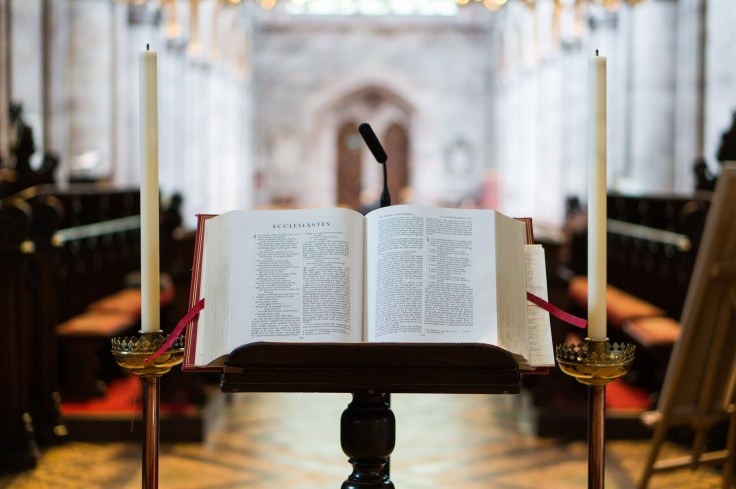
ecclesiastes
Finding Jesus in the Old Testament

There is much to say about this particular topic and there’s no way to do more than scratch the surface in such a short summary. If there are  questions about this in the comments then perhaps I can address this further in a future post. The following big-picture review of the Bible should help you discern how each verse of Scripture points to or flows from the gospel.

Continue reading “Christians & the Old Testament”

Blog at WordPress.com.

Up ↑