

Search

Living Theologically

theology and the Christian life

Tag

Jesus

What does Palm Sunday have to do with Good Friday?

Palm Branch

On Palm Sunday we often talk about the Triumphal Entry, when Jesus entered Jerusalem riding on a donkey and the people gathered to cheer and celebrate him as a prophet, laying palm branches down before him in joyful celebration. This fulfilled multiple prophecies and it showed us a foretaste of Christ’s kingship where all peoples would worship him in glory. It seemed that the Messiah’s plan was being fulfilled, but only a few days later the religious leaders stirred the people against Jesus and they put him to death for blasphemy and treason.

Jesus’ triumphal entry may have begun while riding on top of a donkey, but was fulfilled while carrying his cross to Golgotha on Good Friday. Jesus was a different type of Messiah than the people expected or wanted. They wanted a savior from the Romans who would restore the glory and pure-worship of Israel.

He erased the certificate of debt, with its obligations, that was against us and opposed to us, and has taken it away by nailing it to the cross. He disarmed the rulers and authorities and disgraced them publicly; he triumphed over them in him.
Colossians 2:14-15 (CSB)

Matthew 16:13-28 shows a helpful narrative to set Palm Sunday in context with Good Friday. Once Peter offers the first confession of Christ (“You are the messiah, the son of the living God”), Jesus then begins to tell the disciples that he must go to Jerusalem to suffer and die and be resurrected.

Peter’s rebuke (“Oh no, Lord! This will never happen to you!”) completely makes sense when you put yourself in the disciples’ sandals.

  • You’ve walked the dusty streets, watching Jesus place his hands on lepers. But instead of the leprosy transferring to his flesh, his purity cleanses them and brings healing. (Matthew 8:1-4)
  • You’ve trembled when confronted by the demon-possessed, and yet the demons were the ones who shuddered in fear when Jesus came walking along. (Matthew 8:28-34)
  • You’ve fought against storms on the sea, fearful that your ship was falling apart until Jesus woke up and told the waves to calm down… and they did. (Matthew 8:23-27)
  • During another storm Jesus simply walked on the water, even while it was threatening to sink you. (Matthew 14:22-33)
  • You’ve seen Jesus swarmed by thousands of hungry people and make enough for a small meal feast for the entire crowd… with leftovers. (Matthew 14:13-21)

So when Jesus begins to foretell his death and resurrection, the disciples are rightly shocked. This isn’t what they expected from their master who has shown such great power and authority. Why would he suffer like that?

And not only does Jesus rebuke Peter, he responds by saying, “If anyone wants to follow after me, let him deny himself, take up his cross, and follow me.” He essentially says Peter, not only must this happen to me, it must happen to you too… and to anyone else who wants to follow me. Cross carrying is at the heart of Christianity.

Jesus’ plan all along was to enter Jerusalem triumphantly. Colossians 2:14-15 reminds us Jesus was triumphant over the debt of sin by nailing it to the cross. His hour of greatness was not when he rode into the city on top of that donkey, but when he gave his life on the cross and when he rose victoriously over sin and death.

Note: This is an excerpt based off a sermon I preached on 4/9/17 at Emmanuel Baptist Church. When the sermon audio is online I will include it here when it’s available. 
Why Did Jesus Come? For These Two Reasons…

Who knew that sweet baby boy in the manger would be the most controversial human in history? More ink has been spilled about him than anyone else who has ever lived.

It’s so easy for us to lose sight of the divisiveness of Jesus. He’s one person with whom you can’t sit on the fence: you either believe he is the Son of God and the savior of the world, or you don’t. He is either who the Bible says he is, or he’s just another misunderstood teacher who got himself in trouble by criticizing people of power.

In the midst of all the wrapping paper and Christmas presents, we can easily forget the controversial nature of Jesus’ mission. He was not born simply to provide a nice example for people to follow.

The following are the specific verses where Jesus explicitly says why he came (as well as a few other relevant verses from the New Testament). May these remind you why Christmas is worth celebrating.

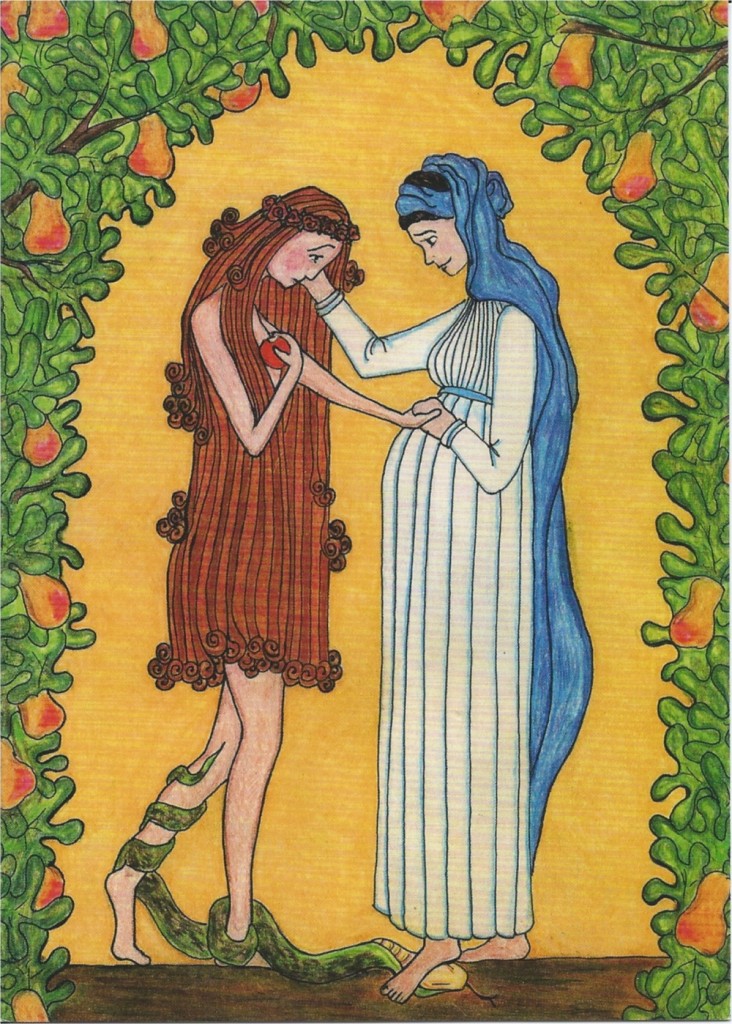
mary-and-eve
Sr Columba Guare © 2005 Sisters of the Mississippi Abbey

Continue reading “Why Did Jesus Come? For These Two Reasons…”

Is Jesus in my Heart?

I used to go to a Christian camp every summer when I was a kid. Almost every year I would be encouraged to “let Jesus into my heart.” I was already a Christian, so this invitation confused me. I know others who always felt pressured and guilty that maybe they sent the invitation to the wrong place or forgot the stamp? Maybe Jesus only visited their heart last year, and this year they hope he chooses to stay. It’s a confusing invitation: letting Jesus into your heart.

What’s that even mean, really? Is it a one-time invitation, and then we’re set for life? Or is it a habitual invitation that we need to keep on issueing so he doesn’t leave?

key with heart
What Does the Bible Mean by “The Heart”
Loving Jesus with your heart isn’t about having warm fuzzies about Jesus. In the Ancient Near East (Egypt, Israel, and the general Mesopotamia region), the heart was treated as the center of a person’s identity. If you want to understand what it means to have God in your heart, you need to know what the Bible means when it talks about your heart.

The heart was the center of people’s mind and thoughts.

“But Mary treasured up all these things, pondering them in her heart.” (Luke 2:19)

“The LORD saw that the wickedness of man was great in the earth, and that every intention of the thoughts of his heart was only evil continually.” (Genesis 6:5)

“Wisdom rests in the heart of a man of understanding, but it makes itself known even in the midst of fools.” (Proverbs 14:33)

The heart drove their desires, decision-making and how they lived their lives (the will). 

“For where your treasure is, there your heart will be also.” (Matthew 6:21)

“But I say to you that everyone who looks at a woman with lustful intent has already committed adultery with her in his heart.” (Matthew 5:28)

“Speak to the people of Israel, that they take for me a contribution. From every man whose heart moves him you shall receive the contribution for me.” (Exodus 25:2)

It also directed people’s feelings and emotions.

“Let not your hearts be troubled. Believe in God; believe also in me.” (John 14:1)

“Yet he did not leave himself without witness, for he did good by giving you rains from heaven and fruitful seasons, satisfying your hearts with food and gladness.” (Acts 14:17)

“You have captivated my heart, my sister, my bride; you have captivated my heart with one glance of your eyes, with one jewel of your necklace.” (Song of Songs 4:9)

To summarize: the heart is way more than butterflies in your stomach. To love Jesus with your heart is to love him with your whole being – with your mind, your desires, your feelings, and with your decisions. Feelings and emotions are not bad, but there’s a problem when they are in the driver’s seat of faith.

Whom Are You Inviting: Jesus or the Holy Spirit?
“Letting Jesus into your heart” would be a really strange idea to the apostles. Jesus Christ is God the Son, the second Person of the Trinity in human flesh. He is fully God, but since he’s also fully human, he could only be in one place at one time… that’s what Scripture means when it says he “humbled” himself and “emptied” himself in Philippians 2:6-8. How could Jesus enter someone’s heart!?

When a person places their faith in Jesus and prays for God to rescue him from sin and guide him into godliness it is not Jesus who “moves in” to the heart. God the Father sends the Holy Spirit to moves in when the heart places its faith in Jesus.

“And I will put my Spirit within you, and cause you to walk in my statutes and be careful to obey my rules.” (Ezekiel 36:27)

“If you love me, you will keep my commandments. And I will ask the Father, and he will give you another Helper, to be with you forever”(John 14:15–16)

“By the Holy Spirit who dwells within us, guard the good deposit entrusted to you.” (2 Timothy 1:14)

“In him you also are being built together into a dwelling place for God by the Spirit.” (Ephesians 2:22)

How We Should Use This Phrase (if you choose to use it at all)
When talking with nonChristians, inviting them to “let Jesus into their heart” is really confusing. It even sounds a bit creepy if you think about it. If you do use this phrase, please remember how the Bible talks about “the heart,” and resist the temptation to make this a sentimental and mushy invitation to become a Christian.

Christianity shouldn’t be built on an emotional high where we cry, pray a “sinner’s prayer,” invite Jesus into our heart, and then we move on like nothing happened. Unfortunately, that’s what often happens when people use this phrase as an explanation of what it means to be a Christian.

Instead, consider the biblical teaching about the heart, described above. Invite nonbelievers to know and experience the love and grace of God through Jesus Christ our Savior. Receiving that grace drives us to love the Lord with all our heart, because living for the glory of God changes us. Encourage new believers (and those who are considering faith, but not yet believers) to remember the call to faith is more than a call to respond to emotional moments.

When we love Jesus we will do what he says, and he will give us the Holy Spirit to strengthen us so we’re able to carry out his teachings (John 14:15-16, quoted above). We are not left on our own to figure out our faith. When we place our faith in Christ we discover that not only does God move in, he gives us a new heart!

It is not Jesus who indwells the believer, but the Holy Spirit. May we all be strengthened to remember the authority and glory of the Holy Spirit, who is active at work in the life of the Christian. May we all resist the emotionalism that sometimes comes with this phrase, and instead, embrace the incredible reality that God is actively working out his plan of salvation from the inside-out in the lives of his people.

(note: this article first appeared on my former blog in January, 2016. This version has been slightly edited to better fit here at Living Theologically.)

Blog at WordPress.com.

Up ↑